
Why Jay Dyer is Wrong about Nominalism and the Reformation
A Metaphysical and Semantic Reply

Recently, Jay Dyer appeared on Tucker Carlson and spoke, in part, about the influence of Nominalism on Reformation thought. Shortly after his appearance on Tucker, Dyer also appeared on a smaller YouTube account: Alex_Ortodoxie. You can see the full interview here. Around the 20 minute mark, Dyer begins to explain his nominalistic narrative about how the Reformation was influenced by nominalism and this leads to the later empiricism of Locke and Hume.
To be quite frank, I think Dyer’s framing misses the most important aspects of medieval empiricism and the nominalistic tradition in the late-scholastics. Because he misreads them, the payoff he wants never arrives. Here, I take up the metaphysical and semantic spine of the argument: the reading of Aristotle, the peripatetic axiom and its slide (supposedly) into a Lockean empiricism, Ockham’s semantics, and what Dyer takes to be the payoff: Damascene’s doctrine of nature. The central story Dyer tells is that nominalism “divorces the signifier from reality”, but this turns out to be false. Once that premise is lost there is no nominalist divorce in the tradition for Luther to inherit. Furthermore, Damascene’s realism refutes Dyer’s claim that Protestants lack any union to Christ via universals.
I’ll take up Luther’s position in a different essay. Here, it is enough to show that the foundation Dyer builds on is not really there to be built on.
One last note before we begin. Dyer’s argument has a real target, but it is not Luther. It is the empiricism that stems from Descartes, Locke, etc. So, I appreciate Dyer striving to avoid the later version of empiricism that does occur, which Hume dismantles, and Kant must restore with his noumenal gap. That picture, however, has no place in the Reformers.
Dyer’s Framing
Along the way, I’ll be referencing parts of the interview with Alex throughout and will indicate where in the video these ideas or quotations are found with time stamps. The story being told by Dyer goes something like this:
Luther’s justification “is influenced by a specific idea of divorcing the signifier from the reality,” which “relates to the denial of universals [but] is not identical to that” (18:50–19:07).
Ockham says universals are “just sets that humans create, a collection of things that share traits”; “a move again away from essentialism, or that things have essences other than just being whatever essence that particular thing is” (29:50–30:29).
“That prepares the stage for Luther looking for a way to have a theological declaration of how you’re righteous even though you’re wicked. There needs to be some divorce between the word and the ontological reality of what you are. And thus nominalism as a systemic approach to naming, declaring and denying the referent is that very ideology… an older Roman Catholic critique of Luther” (31:02–31:59).
“If we’re not perceiving essences then we’re not perceiving any universal thing at all, we’re only perceiving the immediate particulars in sense data. So, you can see how nominalism pretty quickly becomes empiricism, so David Hume and John Locke etc.” (32:40–33:04).
There are more than a few claims that need to be dealt with here, but I’ll only be addressing a few. Let’s start with Dyer’s first move, what he calls the “origin of the dispute” concerning nominalism.
Some Background to Dyer’s Thesis (24:00 - 27:00)
Dyer introduces his approach to nominalism via what he claims Dr. David Bradshaw’s thesis in the first few chapters of Aristotle: East and West. However, I think Dyer deploys a coarser “ranked oppositions” version of it. As a result, Dyer poses questions such as these: Is stasis greater than change? Is eternity superior to time and temporality? Is unity superior to multiplicity? Dyer thinks the Greeks would say, “yes, of course.”
There is much to say in response to this thesis, and some of that will come out in what follows, but to say that “dialectic of ranked oppositions” is somehow the master key to Greek thought is simply 19th century historiography (Hegel and his heirs) read backwards onto the pre-Socratics. As we will see, this is exactly what Dyer does to nominalism as well. There is no flat “yes, of course” answer to these questions. The best example of this is found in Aristotle’s own position. He does not think “one” is a superior/rival entity to the many. He believes that it is convertible, said in as many ways as being is.1
Move 1 - Aristotle’s Step Toward Nominalism
Dyer seems to think that Aristotle makes a step toward nominalism because he rejects the Platonic Forms:
“With Aristotle you have the idea that maybe my teacher isn’t right (Plato) when he talks about this reality to a universal essence or Form or nature that is somehow ontologically transcendent. So, Aristotle says maybe it’s just individual particulars that, in some way, make up a collective substance, there is not a real collective reality that they share. So, technically speaking, Aristotle is a step in the direction of nominalism, even though he is not a nominalist, strictly speaking, because he believes in essences. So, he would still be an essentialist, but he is the beginning of questioning universals as realities or ontologically existing transcendent realities in the realm of the forms." (27:08- 28:04)
Dyer is partially correct here; it is true Aristotle rejects Platonic separation and the Forms as a separate realm. The real error occurs in how he explains Aristotle’s stance concerning “collective substance” and “collective reality.”
What Dyer attributes to Aristotle is the mereological or collectio picture of reality: particulars composing the universal or the species as an aggregate. The collectio view was raised and refuted in the 12th-century. Abelard rejected it precisely because “collections are arbitrary integral wholes of the individuals that make them up, so they simply do not fill the bill of the Porphyrian characterizations of essential predicables such as genera and species.”2 Aristotle’s universal is not built from the particulars. Rather, it is predicated of each of the particulars. In De interpretatione 7, Aristotle states that the universal is “what is by nature predicated of many”, not what is composed of many.
The idea that there is not “a real collective reality that [particulars] share” is false. However, this is an easy mistake to make. There is an ambiguity here that I’m not sure Dyer is aware of. The “collective reality” that is shared could mean two things:
The particulars share numerically one item among them (a single Man-thing divided out to all men). Aristotle obviously denies this, but so does every moderate realist. I’m sure Dyer would deny this too.
It could also mean, specifically one form is shared. This would amount to numerically many but the same in kind. This is what Aristotle affirms.3
So, Aristotle’s picture is the reverse of the collectio framing: the form (a “such,” toionde) is immanent in each individual “this” (particular thing). However, that doesn’t mean the form is not real, it is simply not a definite thing like a particular. That is the equivocation that Dyer’s argument runs on here. A “such” (following the Loeb reading) is a mode of being real, not something that falls short of being real.
In his Posterior Analytics, Aristotle throws out the Platonic forms but keeps a real one-over-many, because without a real universal there is no demonstration.4 This is not a step toward nominalism; it is the founding of moderate realism which rejects Platonism and nominalism alike. The idea that we can read Aristotle as a step toward nominalism only works if you picture one line from Plato to Ockham (or however far you’d like to take the two ends of the line). However, there are two axes to consider:
Axis 1: Location. Are universals separate (transcendent, in a Platonic realm) or immanent (in the things)?
Axis 2: Ground. Is there a real, mind-independent nature/formal content grounding common predication, or is commonality carried only by singulars and their resemblances and a concept? The real vs. mental axis.
Aristotle does not question “universals as realities” as Dyer says. It is true that Dyer immediately follows it up by saying Aristotle questions “ontologically existing transcendent realities in the realm of the forms.” But that’s the point. Dyer seems to think that moving away from the transcendent realities is a move toward nominalism. It’s worth mentioning that the crude three-way sort Dyer’s story leans on (realist, conceptualist, nominalist) is one the leading scholarship explicitly cautions against. Gyula Klima notes that this classification “does not adequately reflect the genuine, much more subtle differences of opinion between medieval thinkers,” and that in fact nearly all of them denied Platonic separate universals while affirming universals ante rem as divine ideas.5 The moderate realist can easily say that universality (which is the one-over-many aspect) is mind-completed, but with a grounding in the thing (outside of the mind). That is very different from resemblance + concept with no common nature in the thing itself.
You may think I’m splitting hairs here, but this very equivocation is what allows Dyer to get to his nominalistic (and eventually anti-empiricism) narrative. He manufactures a kind of slippery slope: Plato (fully real, separate forms), Aristotle (real but less real because they are immanent only), Ockham (only conceptual, even less real), Hume (not even stable concepts exist), then eventually nihilism(?). The strange thing about this is that anti-Platonism begins to read as anti-realism. Furthermore, this is the same move that gives his anti-empiricism claims some bite.
Move 2 - Anti-empiricism and Universals
Dyer’s claim (compressed from his standard formulation) is something like this:
P1. Thomistic epistemology rests on the peripatetic axiom: “nothing is in the intellect that was not first in the senses” (nihil in intellectu quod non prius in sensu)
P2. First principles (the principle of non-contradiction, identity, and the peripatetic axiom itself) are universal and necessary.
P3. Nothing universal and necessary can be found in, or derived from, sense data (no aggregation of sensed particulars yields universality or necessity).
C1. So the “Thomist’s” own stated method cannot ground the first principles it operates by.
C2. Therefore, “Thomism”6 is self-refuting at the presuppositional level, and only the presupposed (Trinitarian) God grounds first principles.
I have no quarrel with P2 or P3. It’s simply true that no aggregation of sensed particulars, as sensed, yields universality or necessity. However, P3 is not the distinctively Humean point that Dyer makes it out to be. Aristotle holds to it in that perception delivers the fact but not the reasoned necessity.7 Kant holds to it in that experience teaches us that a thing is so, never that it must be so.8 Aquinas holds it, and so does Hume. Everyone agrees on the premise, but they infer different things from it.
So, the work is being done by P1, but P1 trades on the same equivocation we saw in Move 1 above. The peripatetic axiom can be read in two ways.
The Origin Reading. On this reading, the intellect’s activity begins in, and is occasioned by, sensation; knowledge does not bypass the senses.
The Content Reading. All intellectual content is nothing but aggregated or processed sense-data.
Aquinas actually holds to the origin reading.9 The content reading actually belongs to John Locke. And here is the important part: C1 only follows on the content reading. If the intellect’s content is nothing but processed sense-data, then P3 does leave the first principles ungrounded, but if the axiom only fixes the origin of knowing, P3 does not do anything since the universality and necessity are contributed by the intellect’s own act, not read off the sensory material.
So, the argument is a bit anachronistic in that it applies Locke’s content-empiricism backwards to some of the scholastic thinkers labeled “Thomists.” We ought not attribute Locke’s version of empiricism to Aquinas (or Aristotle for that matter). However, Hume’s point cuts deeply against content-empiricism.
P3 is actually one of Aquinas (and “Thomism’s”) own premises. In fact, it is Aquinas’ argument for the very faculty Dyer supposes that Thomist lacks. For Aquinas, the senses grasp only singulars,10 but we know universals and necessities. Therefore, there must be an intellectual power, irreducible to the power of sense, that makes the potentially intelligible actually intelligible. That power is the agent intellect. Aquinas states the rationale directly, and it doubles as the exact Plato/Aristotle contrast: ‘The reason why Aristotle came to postulate an active intellect was his rejection of Plato's theory that the essences of sensible things existed apart from matter, in a state of actual intelligibility. For Plato there was clearly no need to posit an active intellect. But Aristotle, who regarded the essences of sensible things as existing in matter with only a potential intelligibility, had to invoke some abstractive principle in the mind itself to render these essences actually intelligible” (De Anima III, lc. 10).11 So, the idea that sense cannot yield universality is a conclusion that Aquinas and Aristotle share.
We could reconstruct part of Dyer’s argument this way:
Q1. On the origin-reading, knowledge begins in sense.
Q2. First principles are universal and necessary.
Q3. Sense data cannot yield universality or necessity.
C. Knowledge is not exhausted by sense; there is an intellectual power beyond it.
That intellectual power is the agent intellect. Dyer’s syllogism just is the “Thomist” syllogism just using the “content reading” of the peripatetic axiom instead of the “origin reading.”
Someone might reply that abstraction is itself just a processing of sense-data since the agent intellect works on phantasms, and phantasms are sensory. But abstraction is not aggregation, just as Aristotle’s universals are not collections of particulars. The agent intellect does not sum or generalize sensed particulars, that would be the “content reading.” The whole point of the agent intellect is to illuminate the phantasm to draw out the intelligible form present in the singular, though not present as sensed.12 The universality comes from the intellect’s light, an active and immaterial power. The phantasm is the occasion and the material from which, not the source or origin, and the intellect working on phantasms does not entail that the content is reducible to the phantasm.
Move 3 - Ockham and the “Sets”
This section will deal with William of Ockham and the next will deal with Dyer’s comments on Luther. Here is the entire transcript of the relevant section from his interview with Alex:
“You come to William of Ockham and he begins to challenge the idea that universals have any real existence. And he’s not a total modernist…, but he’s the first to really begin to challenge the idea of universals having an ontological existence and perhaps they’re also just names, maybe they’re just sets that humans create, a collection of things that share traits. That’s what the set is. It’s not necessarily an ontologically reality that they all share, other than that they have the same traits…. It’s a move, again, away from essentialism: that things have essences other than just being whatever essence that particular thing is. So, there’s a bunch of particulars, they have two legs, two arms, two eyes, that’s “man,” and you can say it’s a set, but the set is just a collection of the particulars together. That’s different from Aristotle or Plato who would say, ‘no, they actually have a common essence or nature that makes them that thing and not another thing….’ That’s what nature/essence is.
So, that’s what sets the stage for Luther looking for a way to have a theological declaration for how you are righteous even though you are wicked. There needs to be some divorce between the word and the ontological reality of what you are. And, thus, nominalism as a systemic approach to naming, declaring, and denying the referent is that very ideology which, not just me, but plenty of people have talked about for many years. So it’s not a new idea.” (29:45 - 31:37)
He then goes on to say that Tim Gordon reminded him that “this is an older Roman Catholic critique of Martin Luther: to divide the ontological status of the thing from the terminological definition or reference to the thing.”
Dyer’s account of Ockham is probably the most accurate stretch of the whole narrative he spins, yet it still goes wrong at the most important point. He is correct that Ockham denies universals any real existence outside the mind, they really are only singulars, and Ockham’s razor cuts away common natures.13
The trouble starts when Dyer claims that universals are “just names” or “just sets that humans create, a collection of things that share traits.” Neither is Ockham’s actual view, as we will see. And the deeper error is Dyer’s phrase that Ockham’s machinery is “a move away from essentialism.” Dyer qualifies this by saying, away from essentialism “other than just being whatever essence that particular thing is.” It concedes that Ockham does really keep essences, it is just the case that each thing is its own essence. What Ockham really denies is a common essence existing as one entity in or over the many (denying both Aristotle’s moderate realism and Plato’s robust realism). I would classify this as anti-realism about common natures, but not anti-essentialism. To call it a “move away from essentialism” is to swap “essence” for “common essence,” so that denying common essences counts as denying essence.
For Ockham, “all we need to assume is that two humans are more similar to each other than either of them are to a brute animal… and that the mind, being able to recognize this similarity, is able to represent humans by means of a common specific concept”; the common terms “directly signify the singulars themselves.”14 There is still a mind-independent fact of the matter about which things are men, grounded in men themselves, not in a set we assemble. In fact, Ockham calls upon John of Damascus to explain common terms:
“In saying ‘Every man is an animal,’ ‘man’ supposits for its significates. For ‘man’ is imposed only to signify these men. For it does not properly signify anything common to them, but rather the men themselves, according to Damascene.”15
The charge Dyer levels against Ockham is that nominalism “divorces the signifier from reality.” But here is Ockham, using John of Damascus, to argue that the term ‘man’ signifies the men, directly. Notice how the universal is not a set or collection that humans create; there is no common thing and no assembled set, the word reaches the individual men. Ockham is a referentialist: terms supposit16 for real singulars, and concepts naturally signify the things that cause them (particulars in this instance).
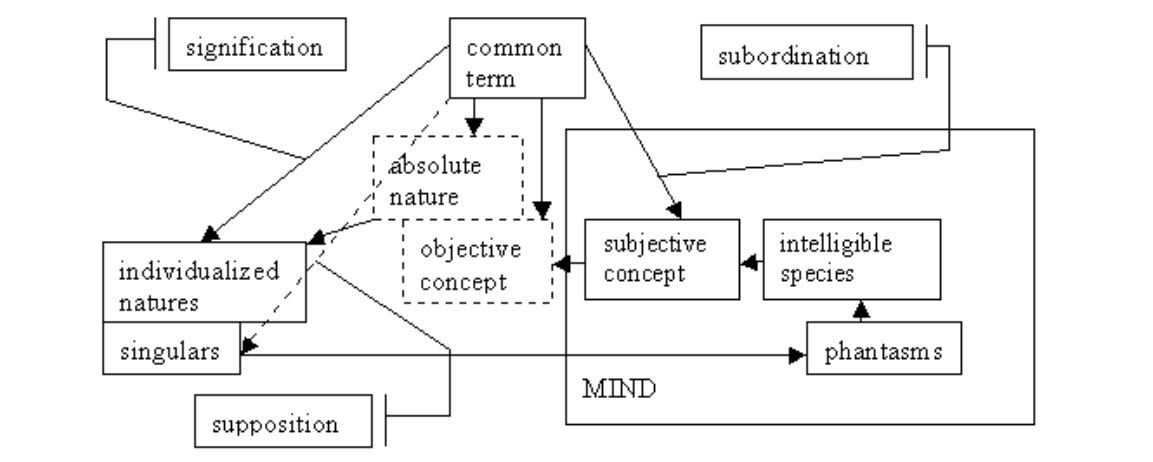
To see Ockham’s project, it helps to set two semantic models side by side.17 The first is the via antiqua conception (the broadly realist model) concerning universals and the second is the via moderna model Ockham initiates:
Here is the moderna model Ockham follows:
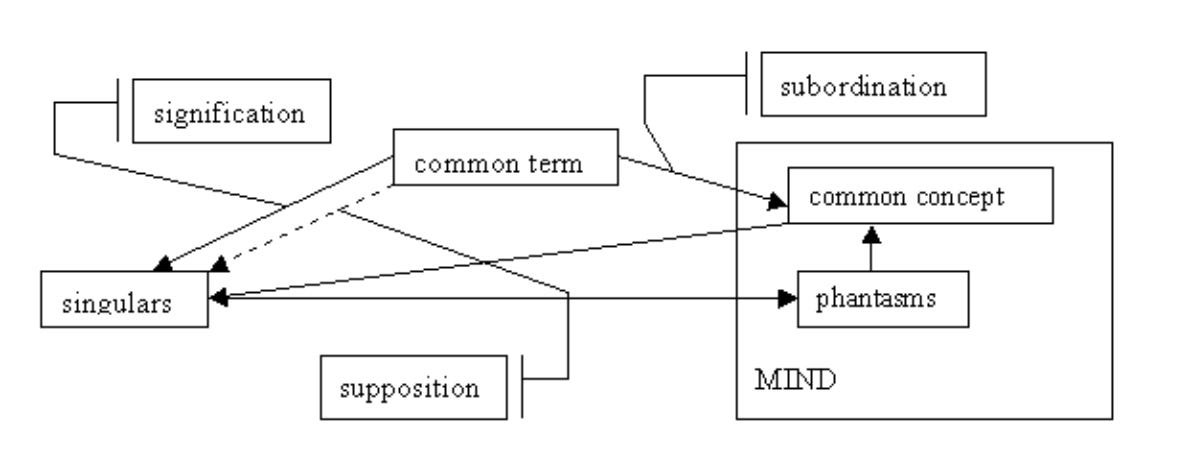
Klima’s own framing undercuts Dyer’s story. The division between the two viae is not a division of metaphysics, but of semantics. As Klima puts it, the “common logical-semantical framework… allows the grouping together of authors who endorse sometimes radically different metaphysics and epistemologies.”18 The via antiqua covered Aquinas, Scotus, and others who disagreed metaphysically. What groups people together is a shared way of relating terms, concepts, and things. So, the move from antiqua to moderna is a rewiring of how signification and supposition work.
Start with what a term does semantically. A term signifies something (its significatum) and, in a proposition, stands for something (its supposita). In the antiqua model, the significatum of a common term is the individualized nature (real in singulars, though distinct from the singulars) while the supposita are the individuals that bear that nature, so the two need not coincide. The moderna model cuts the entire nature apparatus out. For Ockham there are only singulars and concepts. There is no common nature for the term to signify, and its significata just are its supposita, the singulars themselves. That is the anti-realism, a denial of common nature, not universals.
It’s important to note that cutting the common nature is not cutting ties to reality. In fact, in his account of simple supposition, Ockham insists the term still reaches the world:
“Simple supposition occurs when a term supposits for an intention of the soul [i.e., a concept]… For example, in saying 'Man is a species', the term 'man' supposits for an intention of the soul… From this it is clear that those people's opinion is false who say that simple supposition occurs when a term supposits for its significate. For simple supposition occurs when a term supposits for an intention of the soul that is not properly a significate of the term. For such a term signifies true things and not intentions of the soul.”19
A term’s supposition can wander based on the kind of supposition being used (personal, simple or material supposition). However, its signification never leaves the singulars, so the moderna term is tied to reality by its very meaning, whatever it happens to stand for in a given proposition. So, when we say “man is a species,” “man” stands for (supposits) a concept because a species is a concept, not a common thing. But even where “man” stands for (supposits) a concept, what the term signifies is the real men. And in the ordinary case (personal supposition), the term stands for the individuals directly, “it does not properly signify anything common to them, but rather the men themselves,” as Ockham puts it when citing John of Damascus. The moderna term reaches the singulars.
In the antiqua model, a term’s ultimate significata are the individualized natures (the nature as it really informs each singular) while its personal supposition picks out the singulars themselves. Because the individualized nature is a constituent of a composite singular, not the whole of it, the two can come apart (for simple beings like God they coincide).20 The moderna model has no nature level to route through, so a term’s significata just are its supposita: the singulars. Now, it’s tempting to say the antiqua model forces significatum and suppositum apart while the moderna forces them to come together. Klima warns against this: the antiqua model was “no more committed to the real distinction of the significata and supposita… than the via moderna.” The real difference is that the moderna makes their coming together a matter of semantic principle, while the antiqua leaves it to metaphysics whether they coincide. Either way, both models bottom out in the singulars: the antiqua reaching them through the nature that informs them, the moderna reaching them directly. Neither severs the line from word to thing. So Dyer’s claim that “nominalism divorces the signifier from reality” does not represent Ockham.
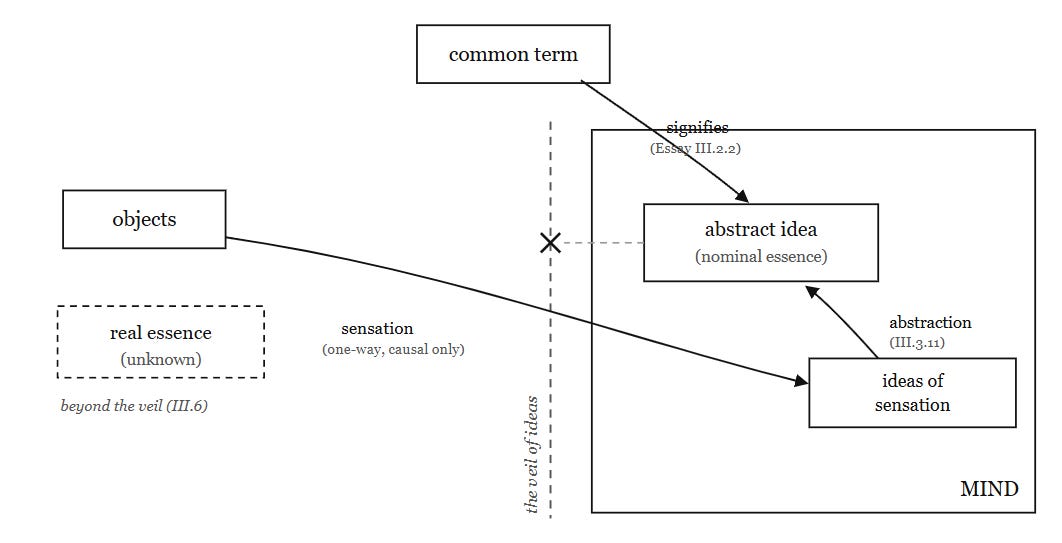
Klima goes on to note that when the two medieval frameworks broke down, “the same problem” re-emerged “in different guises” in early modern philosophy.21 Locke’s philosophy is a perfect example, and it is the one where the representationalist veil of perception appears. Extending Klima’s own schema forward, a Lockean diagram would look like this:
Yet, Dyer says this:
“The Enlightenment figures, I mean, they’re all nominalist…. Empiricism is the logical step beyond Ockham and Biel to say, ‘well, wait a minute, if we are not perceiving essences, then we’re not perceiving any universal thing at all. We are only perceiving the immediate particulars and sense data.’ So you can see how nominalism pretty quickly becomes empiricism. So, David Hume and John Locke, etc.” (32:36 - 33:03)
The immediate thing to notice is that nobody in the medieval debate (including Luther) held that we “perceive” essences. As Move 2 showed, the senses grasp singulars and the intellect knows essences. A second thing to note is the phrase “we are only perceiving the immediate particulars and sense data” is Locke’s picture, not Ockham. Ockham isn’t confined to a stream of particulars.
Look at the models above. The one framework in which the mind is cut off from real essences (reaching only nominal essences) is Locke’s. The antiqua model has the real common nature grounding the shared concept (the “objective concept” is the nature as the mind’s object). The moderna model, although it cuts the nature level, still allows a “common term” (like “man”) to reach through a common concept to the individual thing itself. And in both, abstraction is grounded in the thing; that is, the agent intellect draws the real intelligible nature out of the singular (antiqua model), or the mind naturally forms a concept tracking a real, mind-independent resemblance (moderna model). Either way, the universal answers to something in the thing, and the term reaches it.
Locke breaks away here. He says, “…words, in their primary or immediate signification, stand for nothing but the ideas in the mind of him that uses them….”22 He also says that the general term is “a creature of the understanding,” an invention “made by it for its own use,” whose signification is “nothing but a relation that, by the mind of man, is added to them.”23 Thus, with no agent intellect to draw out an intelligible form, Lockean abstraction yields a nominal essence (a bundle of sensible ideas the understanding sorts, though grounded in observation); the real essence is sealed off as unknown. The medieval intellect abstracts to the quiddity whereas Locke’s understanding builds a nominal essence. This is representationalism.
So, the claim that “nominalism becomes empiricism” trades on an equivocation. The same words (e.g. “abstraction,” “universality in the mind”, etc.) name opposite accounts in the two frameworks. For the medieval, “abstraction” names a real sameness the intellect reads off the particular while, for Locke, it names a relation the mind adds. If you gloss over that difference, Ockham and Locke begin to look the same. But what really happens is that Locke introduces a veil of perception that is in neither of the medieval models. Locke does not inherit the veil from nominalism, he adds it.
If Ockham does not divorce the signifier from reality, then this also has implications for Dyer’s story concerning Luther. Even if we accept that Luther just follows Ockham’s “nominalism”, then Dyer’s point is still moot. As Dyer puts it: “That [Ockham’s nominalism as he explains it above] prepares the stage for Luther looking for a way to have a theological declaration of how you’re righteous even though you’re wicked. There needs to be some divorce between the word and the ontological reality of what you are. And thus nominalism as a systemic approach to naming, declaring and denying the referent is that very ideology.”
Move 4 - The Damascene and the “Universal Human Nature”
Having placed Aristotle as a proto-nominalist and Ockham as a metalinguistic nominalist or a class/set-nominalist, Dyer attempts to recover realism through John of Damascus, and his is where (supposedly) the story is meant to pay off against Protestantism:
“We can actually agree with this [Aristotle’s placing Forms in things] to an extent because St. John of Damascus’ move is to say that the universals are real universals but they exist in the particulars as also universal. So, there is not just particulars. There is not just collections or sets of things, there is also an ontological reality that all human beings have a fundamentally connected human nature and that Christ assumed a universal human nature in a single divine hypostasis. Thus, all men are resurrected because all men are in Christ.”
He’s connecting two things: a claim about universals and a Christological inference drawn from that claim. The first is directly in connection with the previous sections, the second I can only address briefly, as it is a different domain.
First of all, Dyer agrees with the moderate realist that Aristotle was right to put the forms in things, and credits the Damascene with a “moderate realism” as well. But moderate realism (the real nature in the particulars, universality completed by the mind) also belongs to Aristotle, Aquinas, the Lutherans, and other Protestants. If the Damascene’s realism is orthodox, so is Aristotle’s because it is Aristotle’s doctrine. Conceding moderate realism does not sort East and West, it just makes Damascene a proto-nominalist like Aristotle.
I’m going to be a bit nit-picky here. Dyer does say that “St John of Damascus’ move is to say that the universals are real universals but they exist in the particulars as also universal.” But this is ambiguous as stated. Is it a weaker reading so that the nature is really in each particular and its universality (its being a one-over-many) is completed in the mind? Or is it a stronger reading such that “as also universal” means the numerically same universal is present as universal, fact-level, in each particular? The latter is not moderate realism, so I assume he means the former (which is Aquinas’ reading). Damascene himself also seems to block the latter reading in De fide orthodoxa I.8:
“With regard to every created being the distinction between hypostases may be observed as an objective reality. For it is as an objective reality that Peter is observed to be distinct from Paul. But their community of being, relationship, and oneness is contemplated rationally and conceptually. For we apprehend by the mind that Peter and Paul are of the same nature and possess a single common nature. For each of them is a rational mortal animal, and each is flesh ensouled with a rational and intelligent soul. Therefore this common nature is contemplated in the understanding: for it is not the case that the hypostases exist within each other. Each exists individually and apart, that is to say, separately and in its own right, since each has a great many things that distinguish it from the other…. We see this also with regard to creation as a whole. But with regard to the holy, superessential, all-transcending, and incomprehensible Trinity, the opposite is the case. For there, that which is common and one is contemplated in actual fact (πράγματι θεωρεῖται) through the coeternity and identity of its essence, energy, and will….24
The point is that created human nature is not one in fact (as an extra mental reality), but one at the level of contemplation (in the mind). Recall that Ockham wants to say that “man” signifies the individual men and “not anything common to them.” To do this, he cites John of Damascus. The realist Dyer and the nominalist Ockham both claim him, which is exactly what we should expect if the Damascene’s formulas are the common moderate-realist property of the whole tradition (yes, even the Protestants) rather than a device that sorts the true Orthodox from the heterodox (or, as Klima points out, as a device that sorts the viae).
But, there is an even bigger problem for Dyer’s Christological reference that “Christ assumed a universal human nature in a single divine hypostasis; thus all men are resurrected because all men are in Christ.” This claim needs the strong reading that we just saw the Damascene deny! The strong reading says that the universals in things are the same numerical universal so that for Christ to assume it is to assume everyone’s human nature in fact. But the Damascene denies this!
In De fide orthodoxa III.11 he says:
“God the Word Incarnate, therefore, did not assume the nature that is regarded as an abstraction in pure thought (for this is not incarnation, but only an imposture and a figment of incarnation), nor the nature viewed in species (for He did not assume all the hypostases): but the nature viewed in the individual, which is identical with that viewed in species. For He took on Himself the elements of our compound nature, and these not as having an independent existence or as being originally an individual, and in this way assumed by Him, but as existing in His own subsistence.”25
The entire chapter 11 is a textbook deployment of the via antiqua’s threefold nature. It opens by distinguishing three ways “nature is regarded”:
“Abstractly as a matter of pure thought (for it has no independent existence)”. In this sense the nature is considered absolutely/as a being of reason. This is the objective concept in the via antiqua.
“Commonly in all subsistences of the same species as their bond of union”. This is the common nature in things, spread across all hypostases: the universal in the many.
“Universally as the same, but with the addition of accidents, in one subsistence”. This is nature viewed in the individual, or the nature realized in one hypostasis with its accidents: the individual nature.
This is moderate realism: a real common nature, considered abstractly, or as the specific bond across all instances, or as individuated in a single instance. Damascene is running the moderate realism the Latin West also runs.
Now, Dyer’s Christological inference that “Christ assumed a universal human nature…thus all men are in Christ” requires that Christ assumed nature in the sense of #2, the nature common to all the subsistences, so that assuming it is assuming everyone’s. However, the Damascene rules this out:
“God the Word incarnate, therefore, did not assume… the nature viewed in the species (for He did not assume all the subsistences): but the nature viewed in the individual.”
And then he states exactly what Christ did assume:
“And so it is possible to speak of the same thing as being the nature of the Word and the nature in the individual. For it signifies strictly and exclusively neither the individual, that is, the subsistence, nor the common nature of the subsistences, but the common nature as viewed and presented in one of the subsistences.”
The common nature as presented in one of the subsistences is the individualized nature (#3). This is what Klima calls the ultimate significatum, real in a single singular. So, Christ assumed a particular, complete, real human nature, the common nature realized in one hypostasis (His own).
Now, Dyer could point to that fact that Damascene says that Christ assumed “the nature viewed in the individual, which is identical with that viewed in species.” So, is Dyer right? Is the individual nature just the species nature, so Christ actually assumed the universal? Not quite. The Damascene seems to have expected a response like this. As we just saw he directly says, “it signifies strictly and exclusively neither the individual, that is, the subsistence, nor the common nature of the subsistences, but the common nature as viewed and presented in one of the subsistences.” So the identity is same kind, not the same item. Christ’s humanity is of the same nature as every man’s, but it is a distinct realization in one subsistence, not the universal that all men are literally “in.”
Dyer’s cosmic-Christology payoff needs the strong reading of “as also universal.” That is, he needs the numerically one nature, present as universal in all, such that assuming it assumes everyone. But the Damascene picks out the moderate realist approach and closes out the strong reading as an option. He says that Christ assumed the nature in the individual. So “all men are in Christ because He assumed universal human nature” is refuted by the Damascene.
The Luther Charge
Recall Dyer’s two claims about Luther:
Luther’s justification “is influenced by a specific idea of divorcing the signifier from the reality,” which “relates to the denial of universals [but] is not identical to that” (18:50–19:07).
“That [the nominalist story he tells about Ockham] prepares the stage for Luther looking for a way to have a theological declaration of how you’re righteous even though you’re wicked. There needs to be some divorce between the word and the ontological reality of what you are. And thus nominalism as a systemic approach to naming, declaring and denying the referent is that very ideology… an older Roman Catholic critique of Luther” (31:02–31:59).
This article has shown that Luther could not have influenced the “specific idea” of divorcing the signifier from the reality. This idea is a Lockean one. Furthermore, Ockham’s nominalism doesn’t prepare the stage for Luther since Dyer thinks there needs to be some divorce between the word and the ontological reality.
When Luther speaks of justifying faith he is careful to specify concrete vs abstract faith, not faith as a bare quality of the soul, but faith that has laid hold of its object. Justifying faith, for Luther, is a sign united to its referent, not severed from it. Faith is the thing that grasps Christ in the darkness and unites one to Christ just as the intellect reaches reality itself and the mind is united to its object. This is the opposite of Dyer’s story. The righteousness by which the believer is reckoned righteous is Christ’s, and in that sense it is extra nos, but it is not on that account an absent reality that is merely declared. It is a present one, really grasped by faith. Whether and how this faith may then be called the form of the believer (how what is Christ’s becomes our own) is the argument of the next essay. Here it is enough to say that the divorce Dyer requires is no more present in Luther’s account of faith than it was in Ockham’s account of terms: in both, the sign reaches its reality.
Aristotle Metaphysics, X.2, 1053b9-1054a19. Aristotle targets the people who made the One a superior substance over the many (Pythagoreans, Plato), and his counter is that unity is not a rival reality ranked above the many at all: it is convertible with being such that each of the many just is a one. In fact, Aquinas notes this in his commentary on this very section (lectio 3): “A universal also cannot be a subsisting substance, for otherwise it would have to be one thing apart from the many, and then it could not be common, but would be in itself a singular thing. Unity might, it is true, be said to be common in the way a cause is. But the common aspect of a universal differs from that of a cause, for a cause is not predicated of its effects, since the same thing is not the cause of itself. But a universal is common in the sense of something predicated of many things. Thus it must be in some way a one-in-many, and not something subsisting apart from them. But being and unity must be predicated of all things in the most universal and common way. Hence those things that are called being and unity are not themselves subsisting substances, as Plato maintained.”
Gyula Klima, “The Medieval Problem of Universals,” Stanford Encyclopedia of Philosophy (rev. 2022), section 6.
Aristotle, Metaphysics Z.8, 1033b19-1034a8: Is there then some sphere besides the particular spheres, or some house besides the bricks? Surely no individual thing would ever have been generated if form had existed thus independently. Form means ‘of such a kind’; it is not a definite individual, but we produce or generate from the individual something ‘of such a kind’; and when it is generated it is an individual ‘of such a kind.’ The whole individual, Callias or Socrates, corresponds to ‘this bronze sphere,’ but ‘man’ and ‘animal’ correspond to bronze sphere in general…. The completed whole, such-and-such a form induced in this flesh and these bones, is Callias or Socrates. And it is different from that which generated it, because the matter is different; but identical in form, because the form is indivisible.” Note that the passage says the opposite of the idea that particulars make up a collective substance.
For a similar point as the one above, see Aristotle’s Posterior Analytics I.11, 77a5-9: “It is not necessary, in order to make demonstration possible, that there should be Forms or some One apart from the Many; but it is necessary that it should be true to state a single predicate of a plurality of subjects. Otherwise there will be no universal term; and if there is no universal there will be no middle term, and hence no demonstration. Therefore there must be something which is one and the same above the several particulars, and does not merely share a common name with them.”
Klima, "The Medieval Problem of Universals," section 1.
I place “Thomist” and “Thomism” in quotations to indicate that these positions are not well defined and there are too many different kinds of “Thomist” to use this label. Anyways, the focus is on the peripatetic axiom.
Aristotle, Posterior Analytics I.31, 87b28–39 (there is no scientific knowledge through perception; we perceive the particular, but knowledge is of the universal); cf. II.19 on how principles are reached from perception via induction and nous.
Kant, Critique of Pure Reason, B3–4: "Experience teaches us, to be sure, that something is constituted thus and so, but not that it could not be otherwise… this points to a special source of cognition for it, namely a faculty of a priori cognition. Necessity and strict universality are therefore secure indications of an a priori cognition, and also belong together inseparably.”
Aquinas, ST I, q. 84, a. 6. Here Aquinas says that our knowledge originates in sense but is not wholly caused by it; the intellect is a partial, higher cause: “on the part of the phantasms, intellectual knowledge is caused by the senses. But since the phantasms cannot of themselves affect the potential intellect, and require to be made actually intelligible by the agent intellect, it cannot be said that sensible knowledge is the total and perfect cause of intellectual knowledge, but rather that it is in a way the material cause.”
ST I, q. 86, a. 1. On the question of whether the intellect knows singulars, Aquinas says, “The Philosopher says (Phys. i, 5), that the universal is known by reason; and the singular is known by sense.”
Quoted in Klima, “The Medieval Problem of Universals,” section 5.2. Cf. ST I, q. 79, aa. 3–4; Aristotle, De anima III.5. Aristotle likens what is called the agent intellect to light in De anima III.5: “for in a way light makes potential colors into actual colors.” Sensibles actualize the sense power directly, whereas intelligibles are not; so, the intellect, unlike the senses, needs an agent/active power. Contrast Locke, whose mind, lacking any such abstractive power, is confined to ideas copied from sensation (nominal essences) and never reaches the real essence or nature of a thing.
ST I, q. 85, a. 1. Aquinas addresses the question “Whether our intellect understands corporeal and material things by abstraction from phantasms” and answers that it does: “the human intellect holds a middle place: for it is not the act of an organ; yet it is a power of the soul which is the form of the body, as is clear from what we have said above (Q. 76, A. 1). And therefore it is proper to it to know a form existing individually in corporeal matter, but not as existing in this individual matter.” Abstraction is a departure from the concrete and composition is the return to it. The agent intellect gets the universal from the phantasm; composition/division gets you back to the existing thing.
Ockham, Summa logicae I.1, sections 15–16: “The Philosopher [Aristotle] says as much when he says that utterances are ‘the marks of the passions that are in the soul’. Boethius too means the same thing when he says that utterances ‘signify’ concepts. And, in general, all authors, when they say that all utterances ‘signify’ passions [of the soul] or are the ‘marks’ of those [passions], mean nothing else but that the utterances are signs secondarily signifying what are primarily conveyed by passions of the soul.” If we aren’t careful here we might think Ockham is doing exactly what Locke does: words signify concepts such that “man” is about a mental item. But Ockham goes on to refuse this when he says that there are primary and secondary distinctions in signifying. The passion of the soul (concept) is the primary sign. It primarily signifies the things (singulars). That is, it is a natural sign of them. The word or utterance is the secondary sign subordinated to the concept so that it secondarily signifies what the concept primarily signifies (i.e. the things). So, concept and word have the same significata (singulars), the concept naturally and first, the word conventionally and second, by subordination (see the diagram below).
Klima, “The Medieval Problem of Universals,” section 9. Cf. Ordinatio I d. 2 qq. 4–8 (singulars agree se ipsis)
Ockham, Summa logicae, I.64, section 3. Cf. John Damascene, Dialectica, Ch. 10, PG 94, col. 571A.
“Signification” is what a term signifies. “Supposition” is what a term stands for in a proposition. So, in the via antiqua composite substances (anything with form and matter), the nature is metaphysically distinct from the suppositum. For example, “Socrates” does not mean Socrateity. The singular (composite of form and matter) is not the same thing as individualized nature. Except in simple beings (e.g. God).
Klima, “The Medieval Problem of Universals,” sections 8–9. The dashed frames mark items of “reduced ontological status, a 'diminished' mode of being”, the absolute nature and the objective concept, which are beings of reason rather than free-standing things. Importantly, this does not mean they are not real.
Klima, “The Medieval Problem of Universals,” section 1.
Ockham, Summa logicae, I.64, sections 8-9.
On Klima’s reconstruction, the antiqua term runs through a chain: it is subordinated to the concept (the subjective mental act and its shared content: the objective concept), which expresses the nature considered absolutely. That absolute nature is the common content of the individualized natures, which are the term’s ultimate significata, real in each singular. The moderna model cuts the middle of the chain (absolute nature, objective concept, intelligible species), so the term signifies the singulars directly. This does not mean that the singulars have no universal or nature to be spoken of.
Klima, “The Medieval Problem of Universals,” section 10.
Locke, Essay Concerning Human Understanding, III.2.2. Note the contrast with Ockham who says that words do not primarily signify passions of the soul (concepts/ideas), but secondarily signify what the concepts/ideas primarily signify: the things themselves. So, for Locke, our words do not reach through concepts to singulars, but for Ockham they do. Technically speaking the word-concept relation for Ockham is subordination, not signification (see the chart for the via moderna).
Locke, Essay Concerning Human Understanding, III.6, 11.
John of Damascus, De fide orthodoxa I.8.
John of Damascus, De fide orthodoxa III.11.